Build a client request register that reviewers can trust
An operational guide to request identifiers, receipt status, reminders, and engagement review handoffs.
The final week of an engagement is a poor time to discover that “client documents received” means three different things to three people. One team member means an email arrived, another means the files were saved, and the reviewer means the requested evidence is sufficient. A clear request register gives each event its own place.
This guide describes administrative coordination for an accounting practice. It does not delegate accounting conclusions, engagement acceptance, or professional review to an assistant.
Give every request a stable identity
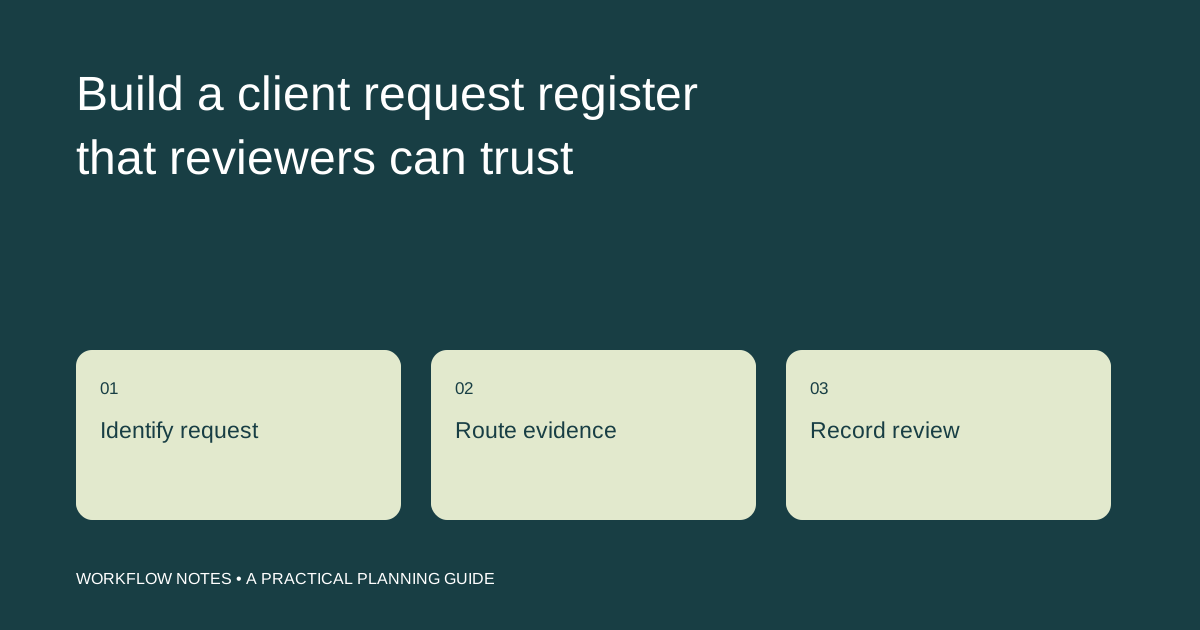
Use an engagement identifier, a request number, and the wording approved by the engagement team. Add the period covered and the person responsible for resolving questions. When a request is clarified, retain its history instead of creating an unrelated item with a similar name.
A stable identifier matters when a client responds in several messages. It lets the coordinator connect each upload to the correct request without deciding whether the underlying accounting treatment is appropriate.
Design statuses around handoffs
A short status vocabulary is easier to maintain than a long list of ambiguous labels. The key distinction is between something arriving and the reviewer accepting it.
| Status | What it establishes | Next responsibility |
|---|---|---|
| Requested | Approved request sent | Client response or scheduled follow-up |
| Received | File or response located | Route to designated reviewer |
| In review | Reviewer has the item | Professional assessment |
| Clarification needed | Reviewer supplied a further question | Send approved wording |
| Closed | Reviewer confirmed completion | Preserve the request history |
Do not use “complete” merely because a folder contains a file with a plausible name. Conversely, do not keep chasing a client after the reviewer has closed the request. Both mistakes come from failing to connect the register to the review decision.
Keep the repository and register connected
Store working documents in the firm’s approved system. The register should point to that location, identify the received date, and record which request the item addresses. Copying entire client records into a tracking sheet creates another place to manage access and versions.
Use the firm’s naming convention and access controls. If an assistant encounters conflicting periods, unreadable files, or a possible duplicate, the useful output is an exception note for the engagement team. The assistant should not silently decide which evidence is authoritative.
Agree on a reminder cadence
The engagement owner should specify when reminders are appropriate and which situations require a personal call. Some clients need a consolidated request; others have multiple contacts responsible for different items. A coordinator can organize these communications, but should not invent deadlines or threaten consequences that the engagement team has not approved.
Before sending a consolidated reminder, reconcile recent uploads and reviewer updates. Include only the open items, use approved language, and name the secure response channel. Record the message so another team member does not repeat it later that day.
Make exceptions visible before the deadline
A useful exception list separates work awaiting the client from work awaiting the firm. For each item, show the current owner, the last meaningful action, and the next review point. This prevents a misleading report in which every unresolved item appears to be a client delay.
Consider an illustrative month-end engagement where one request awaits clarification from the manager while two others await uploads. Reporting “three client items outstanding” sends the wrong signal. The coordinator’s contribution is an accurate classification and a visible next action.
Review accuracy as well as volume
Counting reminders can reward unnecessary activity. Instead, sample the register against the underlying records. Are closed items actually accepted? Do open items have owners? Can the next person find the evidence? Were superseded requests removed from the reminder list?
Begin with one engagement type and refine the workflow before extending it across the practice. Our client document coordination and engagement workflow support services can be scoped around this administrative layer. Bring the request template, approved tools, and review responsibilities to a free consultation so the proposed role has a concrete starting point.